
If early reviews (who bothers with those?) are anything to go by, you’d be forgiven for thinking that Spider-Man: Across the Spider-Verse is up there with the best movies of its generation. You can take this early review’s word for it – it’s not.
Take nothing away from what the film actually is, though. It’s a fun-filled, action-packed and emotional journey with a set of characters who are fast becoming fan favourites. The heights of the franchise opener were just too high to scale.
When 2018’s Into the Spider-Verse first swung into the mainstream, the idea of using parallel universes as a storytelling device on-screen was, for Marvel franchises, a relatively fresh one. It still felt unique.
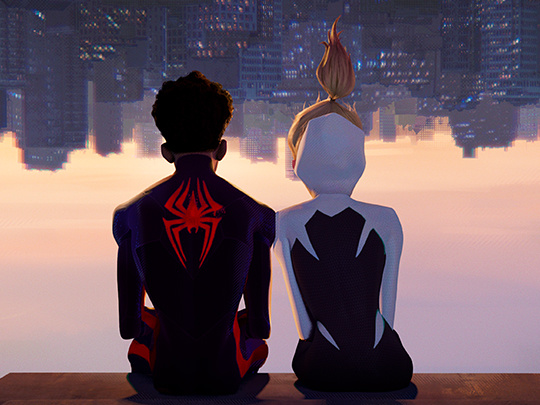
Since then, we have been bombarded with more multiverse content that we need for a lifetime. That didn’t necessarily need to be a problem for Miles Morales and co, but the sequel plot’s similarities to that of flop TV series Loki is a little too frustrating for comfort.
The whole team of self-appointed heroes who reveal that there are certain events that need to happen in order to keep the world in order gig has already been done. It failed to hit the right note the first time, and it falls flat here.
The first movie’s plot was simple enough to keep the story and its characters grounded, with just the right amount of fantastical to wow us. By contrast, Across the Spider-Verse feels rather muddled. It tries to do too much.
Just as muddled (you might need to put me into a witness protection scheme for saying this) is Shameik Moore’s Miles Morales. The linchpin last time around, he genuinely isn’t that likeable for a large part of his return.

Yes, I get it, he’s a 15-year-old kid – but his immaturity is overdone. He speaks over everybody, he doesn’t listen, he acts like a cocky so-and-so no matter what circumstances he is confronted with. Only towards the end of the final act does he start to redeem himself, and the story as a whole improves with that.
His arc is mediocre if at least passable, with the journey he takes in order to appreciate the family and life he has feeling somewhat cheap.
On the other hand, Hailee Steinfeld puts in an outstanding performance as Gwen Stacey. She is, for the most part, the real emotional backbone, and her relationship with her father George and the way in which she lost her version of Peter Parker are heartbreaking.
In her home universe, she is constantly surrounded by paint-like animation, as if an artist of old has once again sprung up their canvas and embarked on their next masterpiece. It’s truly beautiful, encapsulating everything the characters are feeling.

That beauty is felt throughout the film – the action is buoyant, stunning, out of this world. It puts most of its animated counterparts to shame. When Stan Lee and artist Steve Ditko first envisioned Spider-Man and his world in the 1960s, it feels safe to assume that this is what they imagined.
It is no exaggeration to say that both Spider-Verse movies feel as though they have been, in the most outstanding way possible, ripped straight from the pages of a vintage comic book. It’s impossible to put into words the feeling you get as the characters swing from building to building, from scene to scene, and the little kid inside you swells up with joy. Luckily, you don’t need words to soak it in.
This is all set to the backdrop of another enjoyable soundtrack – albeit not as iconic as its predecessor’s – which slots in perfectly with the movie’s themes and characters. Nothing feels out of place, and the production as a whole is impeccable.
But, as the Avatar franchise has taught us, top-of-the-line visuals and sound design aren’t enough to create a masterpiece on their own. A strong lead character, cohesive plot and satisfying story are essential, and Into the Spider-Verse had them all – Across the Spider-Verse falls short.

Even the side characters aren’t as enthralling this time around – the likes of Spider-Man Noir and Spider-Ham were previously both fun and meaningful additions, but Spider-Man India (a creative name), for example, doesn’t bring much to the table.
Oscar Isaac, who is surely (for the sake of our sanity) running out of ways to appear in blockbuster superhero projects, does a decent job as Miguel O’Hara, even if the character is underdeveloped and rather one-dimensional.
The way in which Spot, supposedly the main antagonist, is explored is rather odd. We meet him as a comic relief opponent, one to be quickly overcome as part of a light-hearted scene without being taken seriously.
The issue is that if you set your primary villain up as a laughing stock and then suddenly ask your audience to take them seriously, that’s a challenging 180-turn to make. It takes a while to warm up to the fact that he actually poses a danger and then, before you know it, he’s forgotten for the majority of the run-time before a quick return at the end.
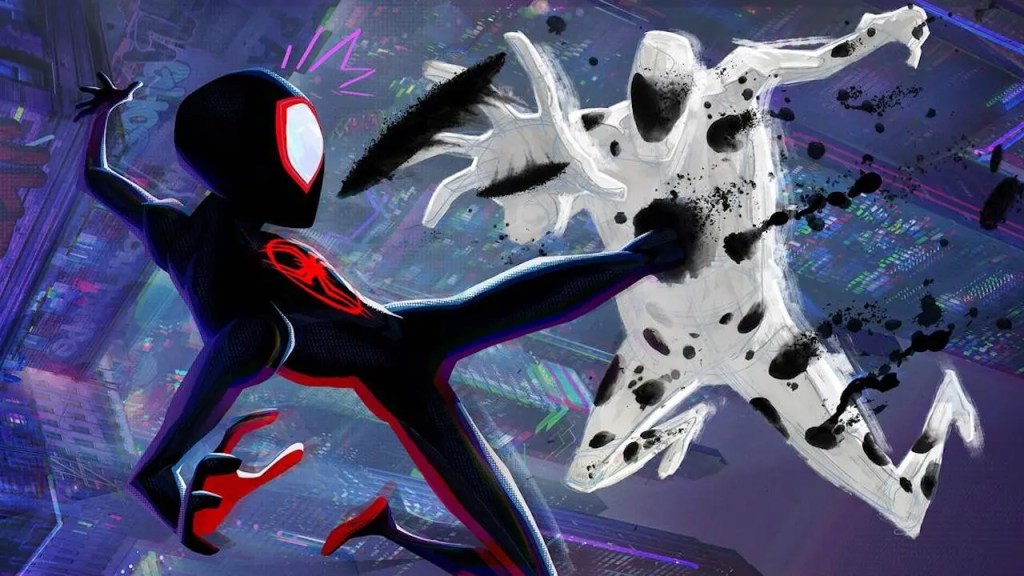
Much is made of Spot’s supposed “connection” with Miles, but very little is actually done to develop it. You have to earn that relationship between hero and villain – you can’t assume your audience will lap it up.
The jury is also out on that cliffhanger ending, setting up a two-parter. I’m not opposed to that in any way, but it does mean that this particular film’s ending feels rushed. It never seems as though we are approaching a natural conclusion, as if this installment is going to get a satisfying round-off of its own.
It’ll work in the short run, but down the line we may look back and realise that it doesn’t really work as its own entity. Two-parters should be able to function as a pair and as a one-off watch.
In the opening 20 minutes, it genuinely feels like Across the Spider-Verse has the potential to cross the threshold into all-time great territory. Unfortunately, a largely messy and aimless middle portion dents those aspirations – but an uplifting and inspirational ending gives us hope going into the next release in March 2024.
It’s not as good as the first, but excels just as much when it comes to painting a rich, sharp visualisation of the comic book world. And isn’t that, after all, what these movies should do?
Rating: ★★★★✰
 A Critical Eye